How to grow your e-commerce internationally
Going international isn’t just about selling in a new market. It’s about feeling local to the people who shop there. Plenty of brands launch abroad, but the ones that actually grow make local shoppers feel at home. That difference, between simply being available and genuinely belonging, is where expansion is won or lost. It’s a lesson we’ve been living ourselves this year, as we’ve grown Qliro beyond the Nordics, into new European markets and onto new platforms.
And every ambitious brand meets it sooner or later. If you run a successful online store in your home market, going international feels like a natural next step. The traffic is there, the product has appeal beyond your home market, and the ambition is in place. So when the numbers abroad come in softer than they should, the reason is rarely demand. It’s friction, and most of it hides in two places. The checkout and everything you assumed was universal but is actually local.
This guide is a practical playbook for closing that gap, built on what actually wins customers when you cross a border.
WHERE DO CROSS-BORDER SALES ACTUALLY GET LOST?
When a new market underperforms, the instinctive reaction is to blame the usual suspects, such as the product, the marketing, or could it perhaps be the pricing? More often, the real answer sits further down the funnel. Shoppers arrive, browse, add items to the cart, and then hit payment methods that feel foreign. Some even scroll straight down to the footer first, hunting for a payment logo they recognize. An unfamiliar way to pay, a price in the wrong currency, a delivery option that doesn’t match how people buy locally, and just like that, they’re gone.
Research compiled by PPRO finds that 99% of cross-border shoppers want their preferred payment method and 94% expect to pay in their local currency. A missing payment option alone can send roughly one in ten away at checkout. The good news is that friction is fixable in a way demand isn’t, and the rest of this guide is about removing almost every reason a willing buyer walks away.
STEP 1: CHOOSE THE RIGHT MARKET BEFORE THE MESSAGE
Expansion often starts with a feeling. A market looks exciting, a competitor just moved there, a big partner keeps asking. There’s nothing wrong with gut instinct, but feelings are a weak basis for entering a market. Behaviour and data are a strong one.
Before you pick a market, look at who’s knocking on your door. Where is your international traffic coming from, and where does it convert worst relative to its volume? That gap is often your clearest signal. Is there proven purchasing behavior for your category? Can you ship there profitably? And do you understand how people in that market expect to pay?
Signs a market is ready for you:
- You’re already getting orders you didn’t go looking for.
- Your category clearly sells online there.
- You can ship and take returns without losing money on it.
- And there’s actually room for you.
Pick one market to start with, the one your data actually points to, and get it fully right before you touch the next. Once it works, you’ll know what to copy into the one after it.
Action: Pull your international traffic by country and flag the one market with real volume but weak checkout conversion. That’s where you start.
STEP 2: LOCALIZE WHAT ACTUALLY MATTERS
When a team says they’ve localized for a new market, they usually mean one thing. They’ve translated the site and switched the currency. That’s the visible part, but it’s rarely what decides whether someone buys.
Real localization is about the parts of the buying experience people actually react to. Language is the obvious one, and the easiest to fix. What quietly decides the sale is more specific. Whether shoppers can pay the way they always do, whether the price shows in their currency with the expected taxes already in it, whether delivery and returns feel normal rather than foreign. Or, put simply – does this feel like it was written for me, or just sent my way?
These are the questions that turn visitors into customers. We stay close to our merchants and see how expansion actually plays out for them, and while it looks different for every brand, the same pattern keeps surfacing.
Madeleine Stern, CMO at Pen Store, put it to us directly:
“If you want to succeed in a new market, you have to be ready to adapt your offer to local conditions. Payment methods, shipping terms, and product prices all need to meet customer expectations in that specific market. Simply translating your website and running the same setup as at home is rarely enough if you want to make a real impact.”
Action: Audit your top market’s experience for the four things shoppers notice, payment, currency and tax, delivery and returns, tone, and fix them in that order.
STEP 3: OFFER THE LOCAL PAYMENT METHODS SHOPPERS EXPECT
This is where international growth is won or lost. And yes, we’re a payments company, so of course we’d say that, but our bias and the evidence point the same way. In most markets there’s a dominant way to pay, and not offering it quietly signals that you’re not really a trustworthy option. Bank-based payments and digital wallets are now expected as standard, and those expectations differ sharply from one country to the next.
Getting this right has a measurable upside. Businesses that offer local payment methods see, on average, a 12% lift in revenue and a 7.4% boost in conversion, according to PPRO, which connects local payment methods across markets worldwide.
No two markets are the same. Shoppers in the Netherlands reach for iDEAL, in Poland for BLIK, and across the Nordics for mobile wallets like Swish, Vipps, and MobilePay, and, crucially, for pay later and invoice in a way few other markets match. In Sweden, for example, invoice is the most-used payment method at checkout (PostNord). If you don’t offer the payment method a market treats as normal, you lose customers who were otherwise ready to buy.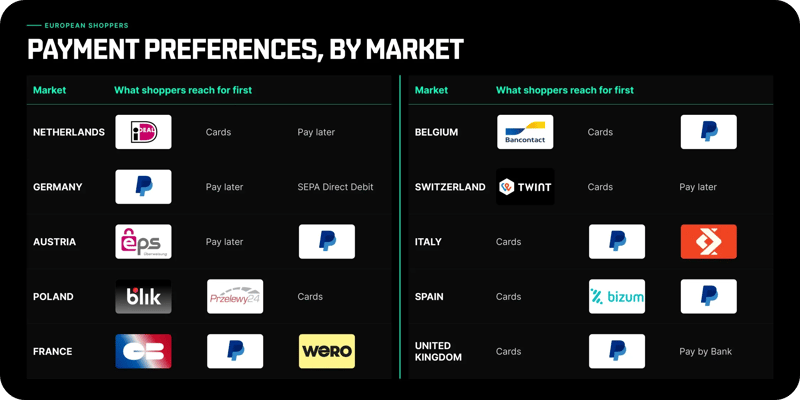
*Data from 2026
Remember, this is not a finish line. The method mix shifts from market to market, and it shifts fast within each one too. Payment habits change. Wero, for example, has grown from launch to more than 50 million users in under two years. In a digital landscape moving this quickly, today’s map might not be next year’s. That’s why the real capability you want from a payment partner isn’t a fixed set of methods, it’s the ability to add the ones that matter in each market, and the new ones as they emerge, without re-plumbing your checkout every time.
Two directions of travel and one rule
This works no matter how you cross a border, because the underlying rule doesn’t change. Shoppers pay with what they know, and meeting that expectation drives conversions.
If you’re a Nordic brand expanding into Europe and beyond, the job is to earn local trust in each new market with the methods shoppers there already reach for, like the ones above. If you’re an international brand selling into the Nordics, the surprise is how distinct the payment culture is. As mentioned earlier, Nordic shoppers rely heavily on paying later and by invoice, to a degree few other markets can match. Buy now, pay later already accounts for around 18% of e-commerce volume in Norway and 16% in Finland (PPRO).
Action: Pick one priority market, add its number one local payment method, and keep cards plus a global wallet as your baseline, so you cover both local habits and global trust.
STEP 4: REMOVE THE TECHNICAL WEIGHT OF EVERY NEW MARKET
Complexity is the quiet killer of expansion plans. But a new market doesn’t have to mean its own integration, its own contract, or its own payout schedule. The goal is to make the technical side really boring through one integration. With Qliro, our modular checkout connects seamlessly with major e-commerce platforms. Getting started usually means just adding our plugin or API, selecting the local payment methods for your target market, and going live without major development work. A modular checkout lets you enable a new market and its local payment methods without rebuilding from scratch, turning expansion from a project into a setting.
This is the foundation of a modern checkout, like our Checkout Generation 4. One base across markets, local methods built in and added as you expand. When the plumbing is handled, your team gets to spend its time on the decisions that actually drive growth, choosing markets, sharpening local relevance, improving the post-purchase experience, instead of managing a sprawl of integrations.
Action: Count how many integrations, contracts, and payouts a new market costs you today. It could definitely be the bottleneck holding you back.

STEP 5: WIN THE WHOLE JOURNEY
The first purchase is really just the starting line, it’s the second order that decides whether the expansion pays off. So, you have to think beyond the sale itself. For example, you need clear order confirmation, smart delivery, and easy returns. This is where trust is either confirmed or quietly lost in a market that doesn’t know you yet. Returns in particular make or break categories like fashion. Make them painless, and you remove one of the biggest reasons people hesitate to buy from a foreign brand in the first place.
Then build on that trust. In a new market the money is in the second order, so give people a reason to come back: a nudge toward the thing they looked at but didn’t buy, a loyalty sign-up offered right at checkout instead of buried in an email, a follow-up that actually matches what they ordered. The catch is that a lot of this only runs on cards. If your checkout can do it on the local methods people there actually use, you have a big advantage right there.
Action: Check your repeat-purchase rate per market, and tighten confirmation, delivery, and returns wherever the second order is spilling.
So, how do you actually grow internationally?
Each step matters on its own, but the real power is how they compound. The right market makes localization worth the effort. Real localization is what makes those local payment methods actually get used. A light technical setup lets you easily repeat it all in the next market. And a strong post-purchase experience turns each new market from a cost into a long-term customer base.
Miss one and the others work harder than they should. Get them in sequence, and each one makes the next easier.
Your international expansion checklist
✔ Map where you already get international traffic, and find where it converts worst. That gap is your starting point.
✔ Pick one market based on behavior and data and commit to getting it fully right before the next.
✔ Localize in order of impact. Payment first, then currency, pricing and delivery, then language and tone.
✔ Offer the dominant local payment method in each market, alongside cards and a global wallet.
✔ Consolidate into one integration, one agreement, and one payout, so a new market is more of a setting than a project.
✔ Design the post-purchase journey (confirmation, delivery, returns, upsell, loyalty) to win the second purchase.
Good luck 👋
Looking for a growth partner to help you take the next step?
International expansion isn’t one big technical project. It’s a sequence of local choices made well. The market you enter, the way you let people pay, the experience you give them after they buy. Get that right, and growth stops feeling like a leap and starts feeling like a repeatable move.
Planning your next market? Tell us about it! We help merchants grow beyond the Nordics with built-in local payment methods and one checkout across markets.
Read more about global expansion with Qliro here.